A thought provoking premise to kick us off: anything we currently babysit code agents into doing well will eventually be internalised by the agents themselves.
A corollary: anything we do interactively during development will eventually be done at runtime autonomously.
Not only the task. The context gathering. The retries. The tool selection. But also the feedback and evaluation loop. And inevitably to do so, the harness: the scaffolding wrapped around the model call.
That is why I think the recent ideas in @AnthropicAI’s dynamic workflows are worth reading beyond development workflows.
Code agents have been the precursor to a broader shift in software runtime, for the class of software that benefits from adapting to recurring intent.
The tools we use today to help agents develop software are likely to become the same class of tools that adaptive applications use to run, reshape, and improve themselves. (just imagine @openclaw and the broader movement of stateful agents)
This is the interesting part of just-in-time harnesses. If you missed it 👇
 Thariq@trq212
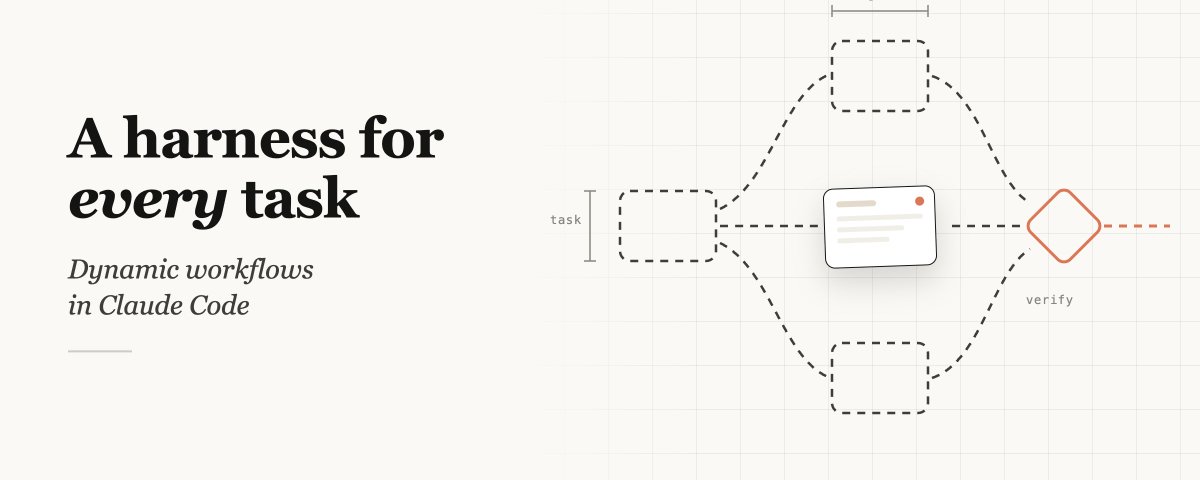 ArticleA harness for every task: dynamic workflows in Claude CodeLast week, we released dynamic workflows in Claude Code. Claude can now write its own harness on the fly, custom-built for the task at hand.
While the default Claude Code harness is built for coding,2 Jun 2026 · View on X →
ArticleA harness for every task: dynamic workflows in Claude CodeLast week, we released dynamic workflows in Claude Code. Claude can now write its own harness on the fly, custom-built for the task at hand.
While the default Claude Code harness is built for coding,2 Jun 2026 · View on X →
They are not only useful for development tasks. They are generically applicable. They can be built directly into the core of a new breed of applications: adaptive applications.
By adaptive applications, I mean software that is not set in stone, but shaped through usage. It ships a fixed base, then accumulates a layer of code built around how each user actually works.
Take these experiments:
1/ a user interface that is forked by the user to match their needs
 Gabriele Farei@jayfarei
A small UX win from my experiments in personalised apps:
1/ “dev mode” lets a user open a git worktree on the app’s extensible core
2/ a local CC session can modify UX or write plugins with live feedback (after passing app tests)
3/ the user approves or rejects the change,
2/ an agentic interface that gets written through usage around their intents
Gabriele Farei@jayfareiHard to explain what a dataset harness like @datafetchai actually is, because it’s an agent-to-agent thing.
So here's the first attempt of many:
Imagine a dataset interface as a code workspace your agent can inspect, run, and compose through typed TypeScript functions.
As
The application does not only respond to a user. It learns the recurring shape of their intent. It improves the way it gathers context. It changes how it composes tools. It adapts the harness around the outcome the user is trying to achieve.
This is what makes code mode interesting. Not simply “tool calling as code.”
Something deeper: code as a generic interface to the environment.
If search, tools, APIs, local files, browsers, retrieval systems, and other environment interactions can be brokered through code, then they can also be generated, composed, reused, and improved as code. Take for example Search as Code 👇
 Perplexity@perplexity_ai
Introducing Search as Code, our new search architecture for AI agents.
It writes Python that calls our search stack directly, instead of looping through function calls one at a time.
Available in the Perplexity Agent API, and now default in Computer.
 1 Jun 2026 · View on X →
The key premise is that models are very good at generating code. They have seen far more of it than bespoke tool-call schemas.
So once the environment becomes reachable through code, the model gets a general-purpose way to act on it. And once the harness itself can be generated as code on first encounter, then committed and reused, the application starts to look very different.
It becomes thinner:
- A place to store code.
- A place to execute code.
- A place to learn from usage and improve that code.
- And, optionally, a surface to render the experience.
This is a big shift from how we usually think about applications.
Most software today is built around fixed workflows. Product teams discover what users need, encode that into flows and interfaces, ship the flows and interfaces, observe the usage, and then iterate.
The cost of software is not only the cost of implementation. It is also the cost of discovering what the software should be.
Adaptive applications change that equation.
They collapse part of the distance between usage and product development. The application can learn the intent shapes that repeat. It can generate or adjust the harness needed to serve them. It can get better every time it is used.
This is why I think the economic objection to the use of AI in applications can sometimes be premature.
Yes, models are still occasionally unreliable. Yes, inference can be expensive. Yes, deterministic software is still cheaper and more predictable for many known workflows.
But that comparison misses the point if we only ask whether AI can replace existing software flows one-for-one. @openclaw didn’t replace an “app”, it created the ability to build personalised workflows, with natural language, just by combining existing primitives.
The more interesting question is: what kinds of products become possible only when the application can adapt?
If the application can learn what each user is trying to do, derive the right harness for that intent, and improve that harness over time, then personalisation is no longer just a recommendation layer locked to a feed.
It becomes an architectural property, creating an app whose operating shape changes around the user.
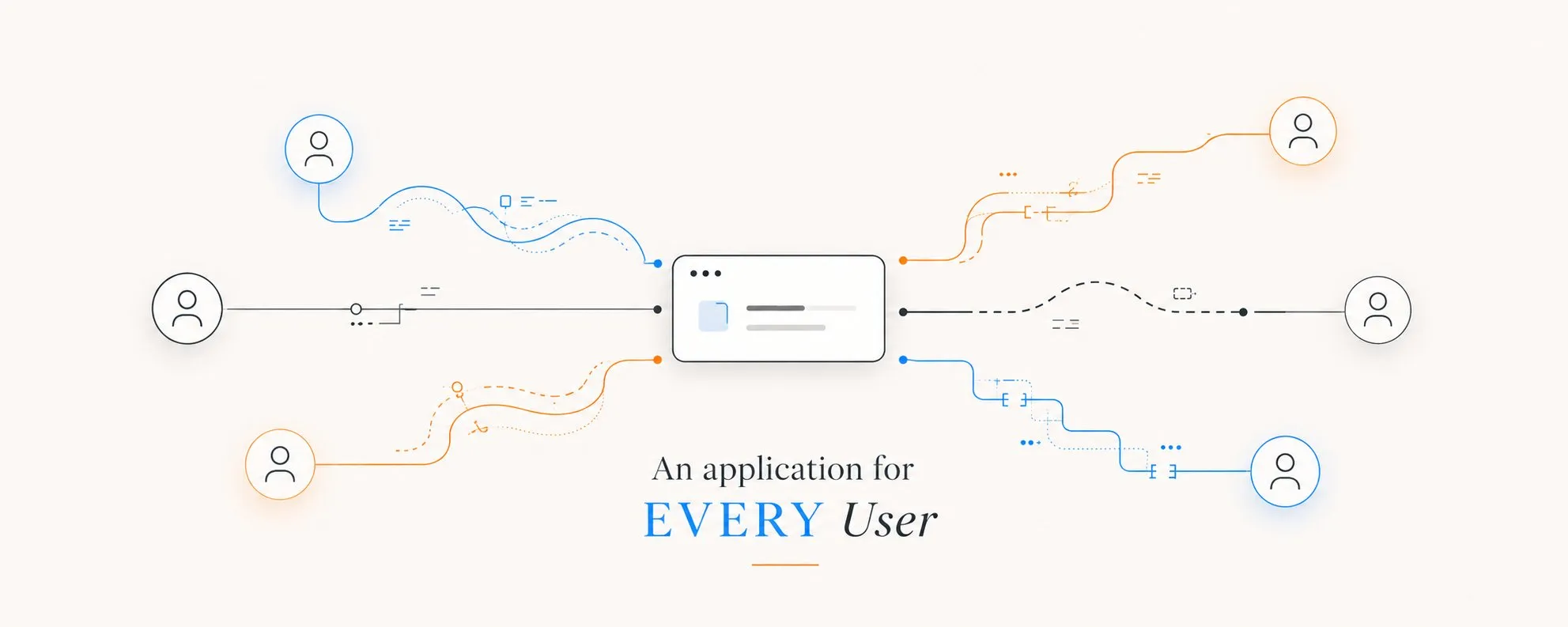
A harness for every task becomes an application for every user.
This might become one of the magic inflection points of AI diffusion, the moment AI stops being a feature bolted onto software and becomes its generative core: personalised applications powered by harnesses that learn recurring intent shapes, recompose themselves on the fly, and improve every time they are used.

That is the research I am doing with @datafetchai (search-as-code) and @envrun (environment-as-code).
If you are interested in collaborating, do reach out 🙏 @jayfarei.
Originally published as an article on X.