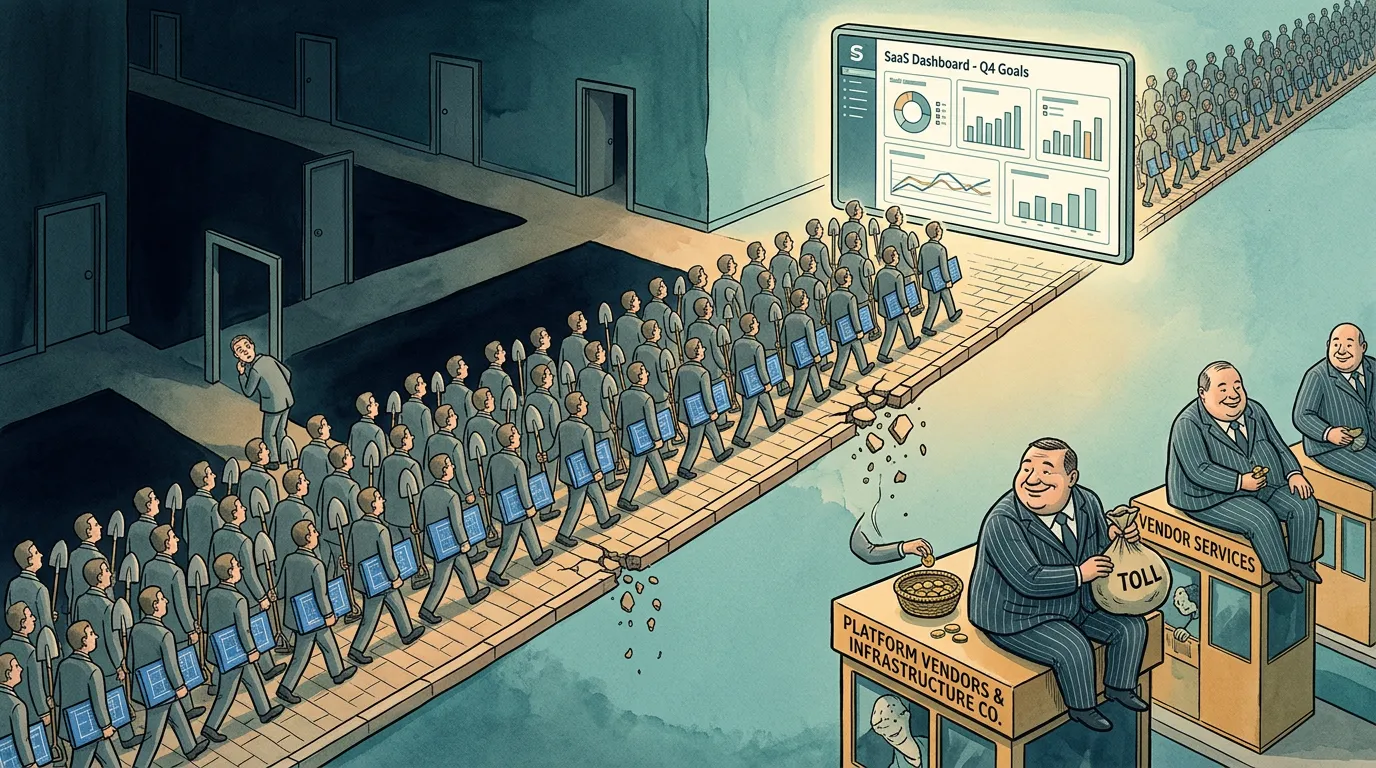
TL;DR: the long-term game has not changed. It is not about doing the easy thing faster.
Follow the current… or not?
When I look back, I think of agentic engineering in waves.
Summer 2024 was the first big one for me. Long nights on Cursor with Sonnet 3.5, doing the “just one more turn” thing over and over again. It was still messy. Lots of errors, lots of steering. But it felt like the first time we were moving beyond clever autocomplete and into something more real. I started to build the internal “context engineering” mental model for agents, and I could feel a new way of building starting to show up.
Then late 2024 brought MCP. We dismissed it, got excited by it and overdid it, then saw its limits more clearly. But it still mattered. It helped make one thing obvious: agents were becoming real consumers of tools and services.
Early 2025 brought another jump. Sonnet 3.7 and Claude Code made things feel more reliable. Claude 4 pushed further on planning, testing, and longer-horizon work. It became less about micromanaging every step and more about setting direction.
Then later in the year came skills. Workflows that had felt half like craft, half like alchemy among early adopters could now be written down, reused, and shared. That made agents better, but it also made the way we worked more legible, more repeatable, and easier to copy.
And by December 2025, with Opus 4.5 and better harnesses, it started to feel like some key aspects of software engineering were on their way to being solved. Not perfectly. Not all at once. But clearly enough that many more people were pulled in.
That is the part I keep coming back to. Every wave brought more people into the stream. That was exciting. But it also pulled more of us toward the same tools, the same references, the same workflows, and eventually the same kinds of products.
It reminds me a little of the pandemic. For a while, attention itself became synchronized. People were looking at the same shows, reacting to the same articles, and slowly starting to act more alike. I think something similar is happening here.
Build fast, crowd faster
The result of these waves is that a lot of old and new builders are learning from the same sources, using the same tools, having the same ideas, and building the same things. And in a competitive market, that herd behaviour does not do us much good.
Yes, the software market is still large. Yes, more people can build than ever before. Yes, the tools are getting much better. But the rewards are still not diffusing evenly.
A lot of the value is still being captured by distributors and shovel sellers: model vendors, infrastructure companies, cloud providers, platforms, app stores, and the layers underneath the boom. Meanwhile indie builders are pushed into increasingly crowded battlegrounds, making products that are faster to build, but also faster to copy and harder to distribute.
If everyone can make a product quickly, product alone stops being enough. That should be the starting assumption. Anything you put together in a night can eventually be reproduced much faster than you think. Maybe by another team. Maybe by a model. Maybe by an agent running the same stack everyone else has access to.
So if you are competing in the most crowded part of the market, like AI tooling or AI-enabled SaaS more broadly, you have to be honest about that. Speed helps, but speed alone is exactly the thing this wave is eroding. Competing only on execution speed, in a world where execution keeps getting cheaper, is not much of a moat.
And I worry that a lot of us are still tech enthusiasts selling to other tech enthusiasts.
We are looking at the same opportunity set, getting excited by the same demos, and solving the same kinds of problems for people who already live inside the tent. Some of those products will still matter. But it is also a very crowded place to stand. And it can trick us into mistaking shared excitement for real demand.
To me, the real work now is not just building faster. It is thinking harder.
What is actually worth building?
Assume the product can already be built. Assume building itself is no longer the hard part. What matters then?
It means asking where this is going, not just what is newly possible in this wave. It means asking what people will need once these tools are taken for granted. It means asking which problems still matter when building becomes cheap. It means asking what does not get replaced just because an agent got better at coding.
That may mean resisting the urge to build the obvious thing just because it is easy to ship now, and instead building for the harder future that is coming. If agentic software keeps improving, a lot of what feels impressive today will become cheap, expected, or absorbed into the baseline. So the better question is not just what can be built now, but what will still matter later.
It may also mean building beyond the current bubble. Too much of this market is still tech enthusiasts selling to other tech enthusiasts. Some of the best opportunities may come from bringing new people into the tent: users, industries, and parts of the world that do not yet have easy access to these tools, and are not already asking for them in our language.
That, to me, is where things get interesting again.
Because what made building exciting in the first place was never just execution speed. It was seeing something a bit earlier. Having conviction where others did not. Looking around the corner. Taking a problem seriously before the rest of the market noticed it.
That is what I think we need more of now.
The paradox of 2026 is that these tools have given individuals incredible leverage, while also pulling many of us into the same current. More people can build. More people do build. But if we all keep building where everyone else is looking, we should not be surprised when the result is a pile of cheap, interchangeable products fighting for the same narrow slice of attention.
So I think the job now is to stop being overly impressed by how much can be built in a day or a week of agentic engineering, and go back to the harder question: what is actually worth building?
Not just what can be built fast. Not just what gets likes and retweets from other people like us.
But what will still matter when the current wave settles, when these tools are taken as given, and when the real bottleneck is no longer making software, but finding something durable, needed, and hard to replace.